
Stop Complaining About your Work and start Lamenting it (Love at Work, Part 4)
Lament is where we begin to see the fallenness of our world more clearly. It is the deep spiritual exercise of love from which new creative actions spring.

In 1983, Nicholas Wolterstorff received a call from Austria at 3:30 pm on a Sunday afternoon to let him know that his son, Eric, had died in a climbing accident; he was only twenty-five years old. Eric had been free-climbing on his own; he had a love of solitude, so no one was there to aid him in his time of need.
In response, Wolterstorff wrote a series of poems and laments which he later published as ‘Lament for a Son’. The laments are a wonderful picture of the depth, variety and rhythm of grief. They speak of the intensity of emotions in unexpected moments; there are personal notes of biography about Eric; there are serious moments of regret and wondering what happened; there are urgent, stark questions to God about life, death and the nature of reality. Yet, in publishing them, he was also shocked at their applicability:
What I have learned, to my surprise, is that in its particularity there is universality. Many who have lost children have written me. But many who had lost other relatives have done so as well, along with many who have experienced loss in forms other than the death of relatives or friends. The sharply particular words of Lament, so have I learned, gives voice to the pain of many forms of loss.1
I experienced this firsthand; I heard of this book in a season of grief which was personal and too difficult to articulate. A form of loss which was real but too hard to name or carry. I didn’t have the words even to name the spaces inside myself, nor what to do with them. When I found Lament, I found a way to live in deep pain with hope. Lament has this power; it is a power which the scriptures themselves hold. So much of them is prophetic or poetic lament. A crying out to God in desperation for his action, his love, his care. A cry in pain for a God to answer. The words of lament give us space and agency to name the spaces of silence we inhabit. They make us more aware, more attentive to what is happening to us and around us.
Lament is, in this way, antithetical to complaining. We all complain about our work; I suspect this is already true of you today. We complain about people, we complain about systems, we complain about industries and technology. Complaining does us no good, for the simple reason that it does not come from nor form us to love. Lament is a spiritual practice of articulating the brokenness of the thing we love and so coming to greater clarity about what it is and why it matters and what is going wrong. Lament is an action of faith, in a way that grumbling and complaining never will be.
One of Wolterstorff’s friends had given a copy of his lament to a number of his children. His reason: “Because it is a love song”. Nicholas contemplated this and agreed: “Yes, it is a love-song. Every lament is a love-song.”2 If we are to grow love at work and so discern courses of action, we need to learn to lament. As we lament, our love will grow, sharpen and deepen in its clarity about our work and the fallenness of God’s world.
The Lost Language of Lament
It appears that modern Christians have somewhat lost the vital and seminal language of lament which runs through so much of the Christian scriptures:
Woven through scripture is an unguarded type of prayer known as Lament. To lament is to ask “Why?” and “Why not?” as well as “What are you doing God?” and “Where are you?” To lament is to pour out our hearts, holding nothing back. It is to pray without trying to be more full of faith than we actually are. Lament is prayer that honors the honesty and the pain and anger while also honoring the truth that God is the one who reigns and whose Hesed never fails.3
The words of Habakkuk, which flow through the whole of his prophecy, are apt:
“How long, LORD, must I call for help, but you do not listen? Or cry out to you, “Violence!” but you do not save? Why do you make me look at injustice? Why do you tolerate wrongdoing? Destruction and violence are before me; there is strife, and conflict abounds. Therefore the law is paralyzed, and justice never prevails. The wicked hem in the righteous, so that justice is perverted.” (Habakkuk 1:2–4)
We see here bound together so many essential elements: the calling out of violence and also the rampant injustice and paralysis of the law which lie behind the increase of conflict and destruction in the society of Israel. The lament presents the issues in their complexity to God in a wrestle to make sense of God’s place in allowing the issues that Habakkuk sees.
Isaiah does something very similar in the opening of his vision. The difference is that it is a word from the Lord. It is the Lord’s own ‘lament’ over his people. God himself instructs us in the love-song which is lament. Jesus himself weeps over Jerusalem, over her inability to come to him and be gathered together as one. The Lord, through the prophet Isaiah, moves from naming specific issues to the deeper issues that lie beneath them.
“Your rulers are rebels, partners with thieves; they all love bribes and chase after gifts. They do not defend the cause of the fatherless; the widow’s case does not come before them.” (Isaiah 1:23)
“Their land is full of silver and gold; there is no end to their treasures. Their land is full of horses; there is no end to their chariots. Their land is full of idols; they bow down to the work of their hands, to what their fingers have made. So people will be brought low and everyone humbled— do not forgive them.” (Isaiah 2:7–9)
There are the problems of political corruption and the abidication of the needs of the fatherless and widows; then there is the delight of wealth and the worship of idols which lies underneath. Laments provoke an interest and attention to problems, a willingness to consider, ‘what is actually wrong here?’ Here the Lord seeks his people to return to him in new terms. When God’s people lament, they urgently seek God’s renewal of themselves and their circumstances.
The most raw of these comes in the psalms, desperate pleas for God’s intervention when everything is not working among God’s people. There are stunning claims upon God’s action, upon his apparent sleepiness and indifference.
“Why, LORD, do you stand far off? Why do you hide yourself in times of trouble? In his arrogance the wicked man hunts down the weak, who are caught in the schemes he devises. He boasts about the cravings of his heart; he blesses the greedy and reviles the LORD.” (Psalm 10:1–3)
Psalm 10 goes on to catalogue before the Lord the workings of such arrogance and greed. The purposeful hunting of the helpless and the willful destruction of the vulnerable. The psalmist asks God to “break the arm of the wicked man” (v.15) because“The victims commit themselves to you; you are the helper of the fatherless.” (v.14 ) This kind of language is not as welcome in the comfortable seeker-sensitive churches of the West. To call on God not only to care for people but to break and destroy wickedness is a level of violence and retribution in language which does not make for certain types of curated gatherings.
It is no wonder that the church has intuitively avoided these psalms. They lead us into dangerous acknowledgement of how life really is. They lead us into the presence of God where everything is not polite and civil. They cause us to think unthinkable thoughts and utter unutterable words. Perhaps worst, they lead us away from the comforttable religious claims of ‘modernity’ in which everything is managed and controlled…The remarkable thing about Israel is that it did not banish ir deny the darkness from its religious enterpirse. It embraces the darkness as the very stuff of new life.4
Recovering lament is to recover an honesty about reality, to own up to the darkness we experience. Israel’s lament attests to the way this honesty is a path to life. We own this too; the Lord Jesus’ loud cries of lament upon the cross are themselves the affirmation of this path and of the way that deadly lament is the wellspring of life. Lament is a form of spiritual attention and love; it is a willingness to move toward what is dark with faith in the God who rules with justice and love.
Lament as Loving Attention to Fallenness
Lament’s honesty is a loving attention to the fallenness and darkness we experience in the course of our working life. Lament is a powerful way of paying attention through public and personal prayer to the issues we face. Not only so, but it is also a way for us to take responsibility for it. When within the gathering of God’s people we lament fallenness together, it lays claim to us:
[Communal Psalms of Lament] are statements about the religious dimension of public events of loss. They permit us to remember that we are indeed public citizens and creatures and have an immediate, direct and personal stake in public events. The recovery of this mode of prayer may be important if we are to overcome our general religious abdication of public issues and the malaise of indifference and apathy.5
Lament is about expanding our moral imagination through declaring the fallenness we see around us. In lament, we are forced to examine the dark, to probe it, but by asking questions of God about what we see, we begin to see its textures anew; we begin to see the interconnected webs of issues, and we begin to long for a change which God will bring about when the world is made new.
When we begin to lament the issues we see in our work, we start to bring our own spiritual categories to bear upon issues we have kept apart from our faith, and we also lift them up to God, spiritually engaging ourselves in matters which we see as practical and mundane.
In lament we are owning the Genesis 3 reality of work. Human sinfulness and the subsequent curse of creation lead to toilsome, difficult and fruitless work:
““Cursed is the ground because of you; through painful toil you will eat food from it all the days of your life. It will produce thorns and thistles for you, and you will eat the plants of the field.” (Genesis 3:17–18)
Toil is painful and difficult. The ground no longer yields its produce to the one who bends their back to work it. Lament pays attention to the reality of work after the fall. Work which is fruitless because of a cursed creation and work which is twisted by the sinful desires of humanity.
Ecclesiastes is to Genesis 3 what Proverbs is to Genesis 1 and 2. An elucidation of the fallen condition of work. In Chapter four, we see the reality of oppression and how there is ‘no comforter’ for the oppressed and all power is at the foot of the oppressor (v.1). Envy, the longing for what another has, becomes the root cause of all work (v.4). Or a restless longing for more which drives work: ““For whom am I toiling,” he asked, “and why am I depriving myself of enjoyment?”” (v.8) Earlier he names the issue of how we mat strive for a legacy only for it to be squandered by those who come after us (2:21) And so: “What do people get for all the toil and anxious striving with which they labor under the sun? All their days their work is grief and pain; even at night their minds do not rest. This too is meaningless.” (Ecclesiastes 2:22–23)
The teacher names the intertwining issues: compulsively driven work by desires out of tilt with God and a love for neighbour. A world in which you can do good work but it is all too easily undone. A world of oppression and brokenness. If we love such a world, if we are interested in it, then we will begin to lament its fallen condition.
Learning to Lament Rather than to Complain
In the faith and work pastor training I conduct in South-East Asia, I run a session on lament. I get pastors and business leaders to sit down and write a lament for their industry or for their city. Then we gather and together lament. It is quite beautiful. Prayers are offered together in Japanese, Nepali, Burmese, Thai and Mongolian. It is a profound spiritual experience to lift up in prayer together what we see and experience on a day-to-day basis. This is often the highlight of the training we do together. It is, in itself, a profound breaking down of the spiritual barriers that lie between our faith and our working life.
How do we write a lament? Well, it begins with an examination of the fallenness we see before us as we work. We need to pay attention to a number of ‘layers’ which may be a part of the issues we see. It is worth just brainstorming what is in front of us as we work, or what kind of ‘trouble’ we find ourselves in as we work. There are so many differing layers to what is happening.
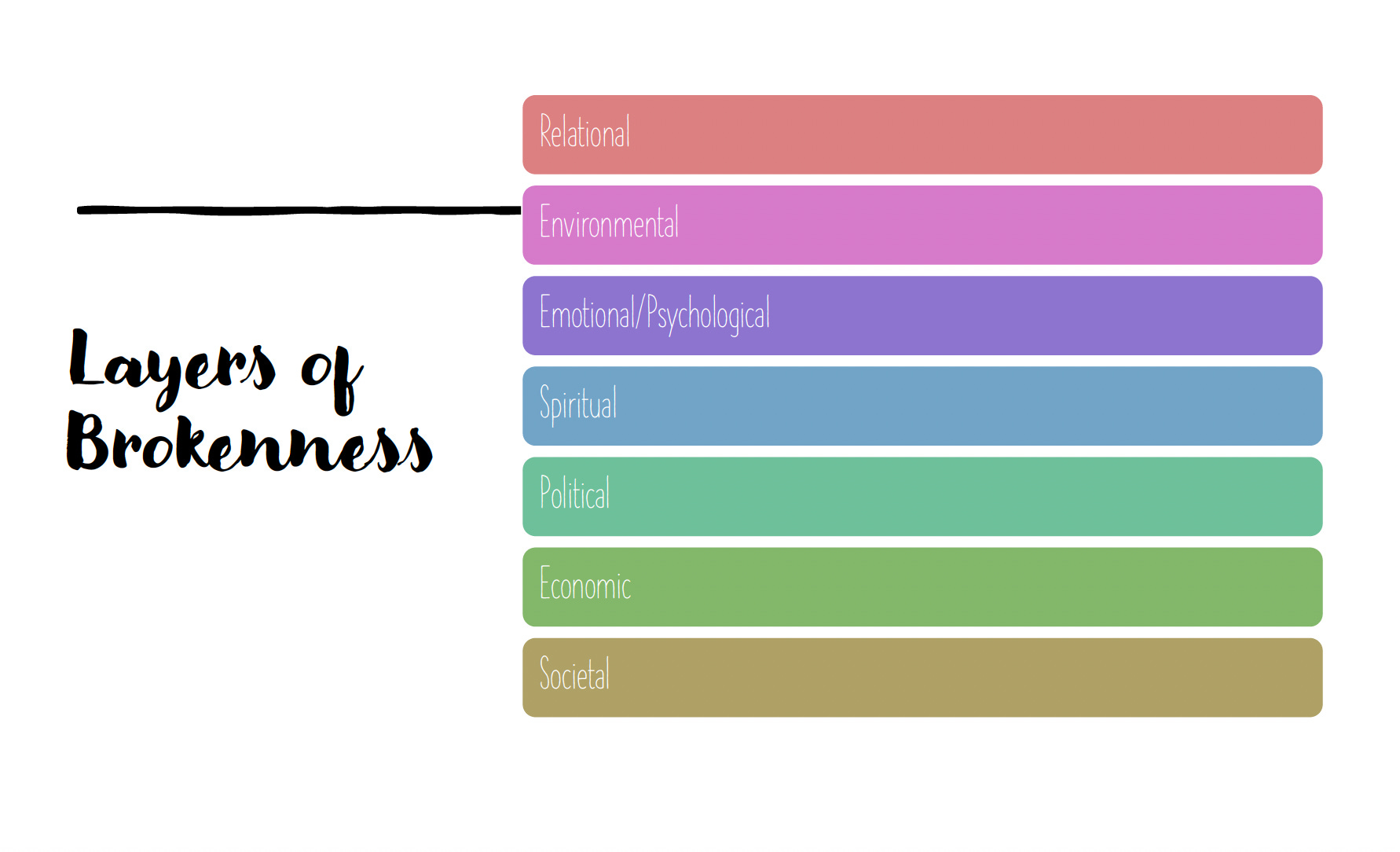
Are there relational impacts at the core of our industry? Whether cultural within our workplace or an impact of our work at large. How does what we do affect the way people relate to each other?
Are there environmental impacts from our work? Are there issues in production which lead to increased pollution? Are there realities of recycling which we have not considered? How does our work impact God’s earth?
Are there psychological and emotional impacts? Does our marketing stir up issues of anxiety inside people? Do we increase the chance of depression or isolation? Do we make people happy?
Are there spiritual impacts? What about our work may be making the vital issues of faith and religion more difficult to see? Does our work make claims about the way the world is? Or does it summon clients to offer themselves to someone ot something?
Are there political entanglements? Does our work hinder the political process, or does it expose a wider political issue that is part of the issue you are facing on an everyday basis? Is there a fundamental injustice which requires new policy or new procedure?
Are there economic realities which impinge upon the way you operate? Are the bigger problems like cost of living or interest rates further exacerbating the issues in your work? How do the problems demonstrate or enfold economic issues?
Are there wider societal patterns which need to be considered? Is there a particular segment of your society who are affected in your work? Especially the vulnerable: fatherless, widows, foreigners and the elderly? How does your work affect wider patterns and systems in the world around you?
Here is how complaints about work can turn into powerful spiritual moments of insight and potential change. What if the things we complain about at work were simply the catalyst for our loving exploration of the web of issues which surround our working context? Our complaints can either make us self-absorbed or they can make us curious about what is actually wrong. It’s quite simple. Start with a complaint you have and work through all the layers above in your work.
As you do that, I guarantee something will stand out: some bigger issue in the midst of them all, some pattern or systems of fallenness, or even some darker motivations and sinful drives that distort human behaviour.
This is another example of what Oliver O’Donovan describes as ‘awakening ’, which is such an essential part for us to discern moral action. When we’ve lovingly explored the fallenness in and around our work, we have a whole host of new possibilities of response in our work. Our embrace of darkness in prayer enlivens our agency to new connections and ways of acting which might make for ‘good work'.
Once you’ve explored these aspects of a ‘complaint ’, you are ready to form a prayer of lament. I recommend something like this:
Begin with Praise. We honour the God who is just, good, beautiful and loving. We need to lift our eyes above what we face to the wonder of the God who is.
Honestly name 2-3 core problems. Focus on some of the biggest issues you see in your industry or your city. The ones that confront you the most. It is important to name the emotional impact of these issues, not just their reality, how they make you feel.
Honestly name drivers of the problems. What darker impulses lie beneath what you see? Greed, love of power, comfort, an idolatry of success, a need to conquer death or to be God in some way.
Call on God to act and respond to these problems. Here we hand the issue over to God; we entrust the problems of our world, knowing they are not first ours to fix; they are in need of God’s attention and his might, his attributes, and his coming Kingdom.
Finish with a word of trust. We finish with confidence in who he is, what he does and how he does it. We trust him, we love him, we adore him even as we wait in darkness.
This is not an idea; I think it will change your work if you do it: a form of love for your industry, your company and your city you may not have imagined. From this grows action, grows a need to respond, but it is rooted first in our honest approach and appeal to God.
Weep, pray, think and do.
Hans R. Rookmaaker, in his polemic book ‘Art needs no justification’. Here he traces the modern dilemmas of the artist who is caught between a world which demands inspiration from art, almost a deep spiritual revelation at times, but refuses to supply the artist with money or means to live on. Artists then feel abandoned by the church because too much of the art world can feel like it glorifies realities antithetical to God. Rookmaaker sees the church's abandonment of art’s place in the world as symptomatic of a larger renouncing of a role in public life. His answer is to: weep, pray, think and do. To feel deep sadness, express it in prayer and then use that as a beginning for new thinking and action.
Weeping is about acknowledging our place in things: “To weep is to see that things must change; to begin to care for the victims, and to pray for forgiveness. Too often we have been accomplices in all that has happened.” Prayer is to acknowledge “that we cannot change things ourselves and we need help… wisdom, strength and perseverance.”6 This then becomes the basis for new biblical meditation and then discernment of actions. For Rookmaaker, the process cannot be circumvented; until we weep and pray, we cannot work out what to do at work. We need to spend time praying in the dark until the light begins to break in.
Rookmaaker sees the possibility of Christians beginning to take art seriously again because “God gave humanity the skill to make things beautiful, to make music, to write poems, to make sculpture and to decorate things.”7 Part of the great problem at the core for artists is the separation of ‘making’ as an everyday activity of normal people. We are called to ‘make’ things; we are summoned to be artisans of various forms. It is only when we lament where art is that we begin again to see the place God gave for such expressions. Art can be used in the service of society, to make clear the reality of the world, the beauty of God and the wonder of what we are a part of.
When I think of the actions which come from the ashes of lament, I think of my friends Phil and Meredith and their board game company, Joey Games. I worked with Phil for a while at a church in Sydney; he is the maker of the remarkable game Sushi Go!, which has a home in pretty much every house I know of. Both Meredith and Phil are people who lament the way the world is; they seek keenly issues of injustice and pain. They have a deep love for God and neighbour. It is their deep love and lament for the way things are that led them to found a new board game company.
Joey Games produces products in reaction to a deeply interconnected set of issues in the modern world through their simple values of: people, planet and play.8 They care for people by making ‘inclusive products’, requiring minimal reading, which ‘share profits’ generously with co-collaborators and so promote diversity. They give to indigenous communities in response to entrenched Australian issues and allow illustrators to ‘retain ownership’ of their own art. The art in their games shows of creaturely diversity in humanity and animal life. They care for the planet by using 100% renewable energy, sustainable materials, avoiding shrink wrap and carbon offsetting their shipping while offering replacement and printable parts to their games. They care about play because it builds deep connections between generations, social and emotional skills and relieves stress. Because they “believe these are important for personal wellbeing and growing strength in communities.”
Also, the games are great! My family loves to play them. Notice the way they contribute to so many ‘layers’ we’ve mentioned of potential falleness and brokenness. Environmental, social, personal, emotional issues for individuals and the world. Here is good work at play, because it has paid loving attention and lamented the way the world is and so chosen a path to love God and neighbour. They are people who weep and pray, who thought and so have acted in profound and deep love.
Here is how an embrace of lament can lead to life, how drawing closer to darkness can lead to life. The path of lament is the loving path of the cross, where we pay such close attention to the way things are that we end up spiritually engaging with them, lifting them to the Lord in prayer and finding new ways of acting in his wonderful world. Here we are driven to work by the death and resurrection of our Lord. Here is where Wolterstorff ended up as he lamented his son as well:
Slowly I begin to see that there is something more as well. To believe in Christ’s rising and death’s dying is also to live with the power and the challenge to rise up now from all our dark graves of suffering love. If sympathy for the world’s wounds is not enlarged by our anguish, if love for those around us is not expanded, if gratitude for what is good does not flame up, if insight is not deepened, if commitment to what is important is not strengthened, if aching for a new day is not intensified. If hope is weakened and faith diminished…then death has won.9
Nicholas Wolterstorff, Lament for a Son (Eerdmans, 1987), 5.
Ibid., 6.
Bethany Hanke Hoang and Kristen Deede Johnson, Justice Calling (Brazos Press, 2016), 82
Walter Brueggemann, The Message of the Psalms (Augsburg, 1984), 53.
Ibid., 67.
Hans R. Rookmaaker, Art Needs No Justification (Regent College Publishing, 1978), 27
Ibid., 40.
https://joeygames.com.au/impact
Wolterstorff, Lament for a Son, 92.
A very helpful reflection, Matt. Thank you. From grumbling to groaning…
I like to practice what preachers preach!
Lament - Education
The economic, environmental, social, spiritual, cultural and bodily situation in public education is lamentable. I have taught at over 50 schools in the past ten years in NSW and Victoria. I know what I am talking about.
Economically, public schools are not serving our country as well as they could be. The Government and taxpayer is wasting their money on parenting children who are at school to be educated- the blurring of these lines can no longer be tolerated if the ship of education is to carry our children anywhere but a fatal shore.
The environment of our public schools are disgusting. Paraded as achievements of modern architecture, most modern schools could be easily mistaken for jails or hospitals. In private and public schools, concrete is embraced as though it were pleasant to hug, trees are treated as inconveniences.
The social life of our schools is ravaged by gossip and slander. Young male teachers can expect to have their sexuality questioned point blank by students upon entering a classroom. Respect is earned according to the social paradigm where students rule. And even when student respect is earned, don't expect your colleagues to follow suit- they might be consumed with petty jealousies that lead to an exuberant classroom being dismissed as a circus. Bullies exist in the staffroom and the playground. A student once told me that she would cut off my balls and feed them to her dog. I don't blame the 14 year old though, her bitter tongue is a defence mechanism against a world that had already let her down in more ways than I could imagine AND she clearly is just a mouthpiece for what adults can't responsibly say out loud, but do think- why else would she NOT be punished for saying something like that? Please see castration culture two paragraphs down.
The spiritual climate of our schools consists of a sickening bipolarity: most teachers use either force or manipulation to control their students. Perhaps more sinister is those who become inordinately affectionate and friendly with the young people they are supposed to be leading. We tend to make the most of inappropriate relationships when they become sexual. It can't be overstated how damaging this is. But there is a cousin to this whose stench reeks strongly from the windows of demountable lunchtime meet-ups I have witnessed: teachers who inappropriately emotionally bond with their students. Often this occurs in the ones least capable of making adult friends. Some people seem to have a free pass when it comes to ignoring professional boundaries. Religion in the schools I have worked in at worst functions as a social club, most terribly where a particular gender is considered more naturally capable of fulfilling spiritual expectations.
The culture of our schools is a sad reflection of the national culture. If it doesn't make money it doesn't make sense. Beauty comes second to utility. Gender propaganda that encourages men to be ashamed of themselves (or perhaps just castrate themselves) and women to think themselves victims since the beginning of time who have every reason to enact vengeance and no reason to seek peace or understanding might have been a clue to the horrendous sexual mess that we find ourselves in where 13 year old girls have their nude pictures shared around entire cohorts of students and teachers who are none the wiser might be confused by their students outrageous violent and filthy mouthed behaviour- but not this teacher- who found out why these young people were behaving this way. The word on the street for the newly introduced age limitation laws for social media is "useless".
The bodies of our students show the most foul signs of neglect, self hatred and shame that corresponds with a culture that aborts young people at an unspeakable rate. Young men constantly covering their faces with beanies or hands. Other young men pathetically parading around their oddly muscular bodies, jacked up from a gym routine that seeks attention from God only knows who (their father? their mother? their peers? their teachers? the opposite gender? the same gender?). Perhaps they just want SOMEONE to look up from their phone and look them in the eye. Young women wearing something close to nothing, or else long sleeve shirts and jumpers to cover up their cutting.
Do you see what I see? Or do you look away?
Usually, I would add the healthy alternatives to the above mentioned mess. But that is for another time. Rich people everywhere! Let the lamentation begin